 nurbook
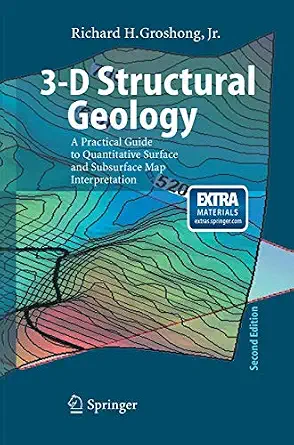
3-D Structural Geology: A Practical Guide to Quantitative Surface and Subsurface Map Interpretation 2nd Edition
Author(s): Richard H. Groshong (Author)
- Publisher: Springer
- Publication Date: July 9, 2006
- Edition: 2nd
- Language: English
- Print length: 416 pages
- ISBN-10: B001C7Y9B6
- ISBN-13: 9783540310556
Book Description
{“@context”:”https://schema.org”,”@type”:”Book”,”name”:”3-D Structural Geology: A Practical Guide to Quantitative Surface and Subsurface Map Interpretation 2nd Edition”,”image”:”https://m.media-amazon.com/images/I/51vBNa5sx+L._SY445_SX342_QL70_FMwebp_.jpg”,”author”:{“@type”:”Person”,”name”:”Richard H. Groshong (Author)”},”publisher”:{“@type”:”Organization”,”name”:”Springer”},”datePublished”:”July 9, 2006″,”isbn”:”9783540310556″,”numberOfPages”:416,”inLanguage”:”English”,”description”:”Geological structures are three dimensional, yet are typically represented by, and – terpreted from, outcrop maps and structure contour maps, both of which are curved two-dimensional surfaces. Maps plus serial sections, called 2½-D, provide a closer approach to three dimensionality. Computer technology now makes it possible for geological interpretations to be developed from the beginning in a fully three dim- sional environment. Fully 3-D geological models allow significantly better interpre- tions and interpretations that are much easier to share with other geologists and with the general public. This book provides an overview of techniques for constructing structural interpretations in 2-D, 2½-D and 3-D environments; for interpolating – tween and extrapolating beyond the control points; and for validating the final int- pretation. The underlying philosophy is that structures are three-dimensional solid bodies and that data from throughout the structure, whether in 2-D or 3-D format, should be integrated into an internally consistent 3-D interpretation. It is assumed that most users of this book will do their work on a computer. C- sequently, the book provides quantitative structural methods and techniques that are designed for use with spreadsheets, mapping software, and three-dimensional c- puter-graphics programs. The book is also intended to provide the background for understanding what interpretive software, for example, a computer contouring p- gram, does automatically. Most techniques are presented in both a traditional format appropriate for paper, pencil, and a pocket calculator, and in quantitative format for use with spreadsheets and computer-graphics or computer-aided-design programs.”,”bookEdition”:”2nd”,”url”:”https://www.amazon.com/dp/B001C7Y9B6/”,”bookFormat”:”http://schema.org/EBook”,”additionalType”:”http://schema.org/PDF”,”fileSize”:”52 MB”,”accessibilityFeature”:[“login required”,”member access only”],”accessibilitySummary”:”PDF version available to authenticated members only. File size: 52 MB.”}