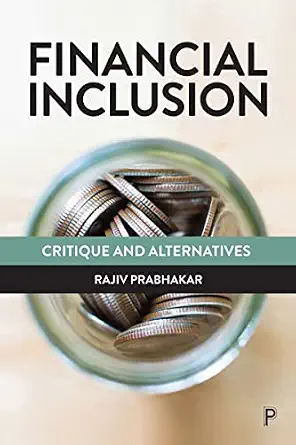
Financial Inclusion: Critique and Alternatives
Author(s): Rajiv Prabhakar (Author)
- Publisher: Policy Press
- Publication Date: February 17, 2021
- Edition: First Edition
- Language: English
- Print length: 178 pages
- ISBN-10: 1447355938
- ISBN-13: 9781447355939
Book Description
Should the public play a greater role within the financial system?
Decisions about money are a part of our everyday lives. Supporters promote financial inclusion as a way of helping people navigate decisions about money. However, critics fear these policies promote the financialisation of the welfare state and turn citizens into consumers.
Presenting a nuanced, critical analysis of financial inclusion, Rajiv Prabhakar brings together the supportive and critical literatures which have, until now, developed in parallel. Addressing key issues including the poverty premium, financial capability and housing, this essential dialogue advances crucial public, academic and policy debates and proposes alternative paths forward.
Editorial Reviews
Review
“This engaging and timely book makes a convincing case for bringing together theoretical and applied perspectives on financial inclusion in order to develop both a more nuanced understanding of this important issue and a more theoretically grounded set of policies to reduce the poverty premium.” Karen Rowlingson, University of Birmingham
“Rajiv Prabhakar’s discussion of the arguments for and against the inclusion of disadvantaged groups in the world of finance and asset ownership is a major contribution to the debate. His analysis of alternative policies towards inclusion is a must-read.” Julian Le Grand, Marshall Institute, London School of Economics
Review
“Rajiv Prabhakar’s discussion of the arguments for and against the inclusion of disadvantaged groups in the world of finance and asset ownership is a major contribution to the debate. His analysis of alternative policies towards inclusion is a must-read.” Julian Le Grand, Marshall Institute, London School of Economics
About the Author
Rajiv Prabhakar is Senior Lecturer in Personal Finance at The Open University and a Senior Fellow of the Higher Education Academy.
View on Amazon
 nurbook