 nurbook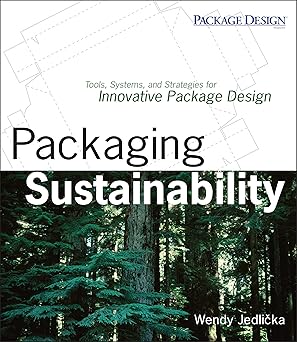
Packaging Sustainability: Tools, Systems and Strategies for Innovative Package Design
Author(s): Wendy Jedlicka (Author)
- Publisher: Wiley
- Publication Date: December 31, 2008
- Edition: 1st
- Language: English
- Print length: 368 pages
- ISBN-10: 0470246693
- ISBN-13: 9780470246696
Book Description
Take the lead with sustainable package design solutions
The classic role of packaging is to “Protect, Inform, and Sell.” Today, packaging must do all that―but with minimal eco-impact. Packaging Sustainability: Tools, Systems, and Strategies for Innovative Package Design is a comprehensive guide to thinking outside the box to create practical, cost-effective, and eco-responsible packaging.
With a broad range of contributions from pioneers of sustainability, Packaging Sustainability not only describes the concepts of sustainability but reveals the logic behind them, providing you with the tools to sift through and adapt to the ever changing barrage of materials, services, regulations, and mandates. The book:
- Enables the designer to make smart, informed decisions at all points throughout the packaging design process
- Offers a comprehensive overview of sustainable packaging design issues from leading practitioners, designers, engineers, marketers, psychologists, and ecologists
- Describes materials and processes in current use and helps the reader understand how they interconnect
With solid information and actionable ideas, Packaging Sustainability gives you all the tools for maximizing a product’s shelf impact―while minimizing its ecological footprint.
Editorial Reviews
From the Back Cover
Take the lead with sustainable package design solutions
The classic role of packaging is to “Protect, Inform, and Sell.” Today, packaging must do all that―but with minimal eco-impact. Packaging Sustainability: Tools, Systems, and Strategies for Innovative Package Design is a comprehensive guide to thinking outside the box to create practical, cost-effective, and eco-responsible packaging.
With a broad range of contributions from pioneers of sustainability, Packaging Sustainability not only describes the concepts of sustainability but reveals the logic behind them, providing you with the tools to sift through and adapt to the ever changing barrage of materials, services, regulations, and mandates. The book:
- Enables the designer to make smart, informed decisions at all points throughout the packaging design process
- Offers a comprehensive overview of sustainable packaging design issues from leading practitioners, designers, engineers, marketers, psychologists, and ecologists
- Describes materials and processes in current use and helps the reader understand how they interconnect
With solid information and actionable ideas, Packaging Sustainability gives you all the tools for maximizing a product’s shelf impact―while minimizing its ecological footprint.
About the Author
WENDY JEDLIČKA, CPP,is president of Jedlička Design, Ltd and a member of the faculty at Minneapolis College of Art and Design’s groundbreaking Sustainable Design Certificate Program. A Certified Packaging Professional, she serves as national chapter co-coordinator for the O2 International Network for Sustainable Design (o2.org) in the United States as well as O2’s Upper Midwest chapter chair, and she is the contributing coordinator for Package Design Magazine’s Sustainability Update feature column.
Excerpt. © Reprinted by permission. All rights reserved.
Packaging Sustainability
Tools, Systems and Strategies for Innovative Package DesignBy Wendy Jedlicka
John Wiley & Sons
Copyright © 2009Wendy Jedlicka
All right reserved.
ISBN: 9780-470-24669-6
Chapter One
Taking the First Step
Wendy Jedlicka, CPP Minneapolis College of Art and Design Sustainable Design Certificate Program
With additional contributions from: Caux Round Table, Ceres, Packaging Strategies, Sustainable Is Good
The longest journey begins with a single step. Lao-tzu (c 604-531 bce)
How do market forces shape the way we live, work, and even play? What are the economic lessons that can be drawn from nature? What is natural capital and how is it spent? How can we nurture the green thumb on the invisible hand? Today’s eco-leaders understand the interplay between producer and consumer, governments and people, stockholders and stakeholders, humans and the environment, and how all of these things interconnect and direct what and how we create.
Consumption and Renewal
The concept of birth > life > death is linear. It has a beginning, a middle, and an end. We view the things we surround ourselves with as having the same linear quality. Things are made, we use them, and then toss them away. But the reality is, there is no “away.” Products and their packages have a life after we use them, as garbage (landfill or incineration) or feeder stock for new objects (recycling or reuse reclamation). When objects are reborn (recycled or reclaimed) and put back into the system again, this becomes circular consumption and thus imitates nature: making, using, and remaking without limit. Imagine an upwardly spiraling system where we not only refresh what we take and use, but restore what we’ve previously destroyed through linear consumption. To get to this level we need to start reexamining not just how we do what we do, but why we do it.
Choices, Choices, Choices
Many examples of human impact on the environment abound in both recent and ancient history. The best-known one is the fate of the Easter Islanders. This group, it has been suggested, drove themselves to extinction by their own excesses and severe lack of planning. As we consider the choices we make each day, think about too what must have been going through the mind of the Easter Islander who cut down the last tree, leaving his people no way to build, repair, or heat their homes, build or repair boats to fish (their main food source), or even get off the island. With a simple strike of his axe he sealed their collective fate.
We must hope in our lifetime, we will not be faced with this dilemma, but every choice we make each day adds or subtracts from the resources available to us tomorrow. Bad choices are accumulating like a death by a thousand cuts. Our salvation will come in much the same way, by regular people making everyday choices.
One of the most powerful avenues for impact we have is what and how we choose to consume. What we buy reveals a lot about how we frame our own impacts. Buying a perfect red apple vs. one that is kind of blemished but just as sweet and free of chemicals needed to attain that perfection, would be a great example.
Heritage Flakes by Nature’s Path uses organic grains, and supports sustainable farming practices and biodiversity efforts. They also really understand their buyer.
Not only does the box illustrate an attractive product, plus key into potential buyers looking for more healthful choices and good taste, they also realize they needed to seal the deal by creating and talking about, their packaging reduction efforts. Same net weight, 10% less box is featured on the front. Finally, someone addressed one of the things that has been a nagging thorn in the consumer’s side since boxed cereal came on the scene over 100 years ago: how to fill the box and not leave such a huge space at the top. For most people, this is one of those packaged goods annoyances that just must be endured.
On the product’s side panel, Nature’s Path continues the discussion of packaging reduction by providing information regarding annual water savings (700,000 gallons), energy savings (500,000 kilowatts), and paperboard savings (about 1300 trees). These are serious and significant impacts all coming from what is in essence just a bit of air space. Now, along with information detailing nutrition and sustainable production practices, not only can the consumer make an educated decision about the food they eat, but about the impact of that choice. By connecting with the consumer on a deeper level, Nature’s Path has armed them with the information needed to know they do have a choice – and what instinctively seemed wrong, was indeed very wrong.
As we look at the decisions we make with regard to design, in order to achieve more than simply making things less bad, we have to provide the mechanism for the consumer to participate in the pursuit of good.
Like Nature’s Path, we need to consider all of our design choices as part of a greater contract with society. As product producers, we’re charged with nothing less than the health and safety of our fellow beings. Nowhere was this contract more brutally illustrated than in the case of the Tylenol murders in the early 1980s, which showed how easily our distribution system can be compromised.
At the time, Johnson & Johnson, the makers of Tylenol, were distributing their product using common and completely legal packaging technology for this product category. To their credit, Johnson & Johnson responded quickly and decisively. They not only pulled all of their products immediately from the store shelves, but became very proactive in the development of tamper-evident packaging – the norm across the pharmaceutical industry today.
Underconsumption
It’s odd to think of not consuming enough, but this in fact is a very real problem. Malnutrition is a form of underconsumption (not having access to enough nourishment), and so is lack of education (not taking in or being allowed access to knowledge). One might also consider lack of research and the foresight it enables a type of underconsumption (not consuming enough time to make sure what you’re going to do will be smart in the long run). There are also systematic imbalances caused by underconsumption.
Deer overpopulation and subsequent overgrazing and habitat destruction are due to too few predators to help keep herds in harmony with the area that sustains them. This is a classic example of an imbalance caused by man’s interference. The deer herd’s health and their environment’s health suffers (too many deer for a given area to support), as the deer are underconsumed because the wolves that helped keep them in healthy balance were overconsumed (hunted to near extinction).
By being aggressive about keeping forests under-consumed by small fires, as had been the standard mode of forest management for the past century, too much underbrush is allowed to build up. What had been taken care of by nature’s renewal system, quickly becomes a devastating catastrophe resulting in complete ecosystem collapse. More progressive forest managers have found that working within nature’s plan allows their areas to remain healthier, more diverse, and better able to recover after disturbances.
As we begin to look at our products and behavior with an eye to restore what we’ve been taking out of our natural systems rather than create unstable monocultures for our convenience, looking for balance becomes key. We must look at things as a system and find ways of working to maintain all elements in harmony. Yet to do this, we need to not rush to find “the” solution: one that is convenient for us at the time, but completely ignores long-term impacts.
Overconsumption
Writer Dave Tilford tackled the idea of consumption in a 2000 Sierra Club article, “Sustainable Consumption: Why Consumption Matters”:
Our cars, houses, hamburgers, televisions, sneakers, newspapers and thousands upon thousands of other consumer items come to us via chains of production that stretch around the globe. Along the length of this chain we pull raw materials from the Earth in numbers that are too big, even, to conceptualize. Tremendous volumes of natural resources are displaced and ecosystems disrupted in the uncounted extraction processes that fuel modern human existence. Constructing highways or buildings, mining for gold, drilling for oil, harvesting crops and forest products all involve reshaping natural landscapes. Some of our activities involve minor changes to the landscape. Sometimes entire mountains are moved.
An ecological footprint is defined as the amount of productive land area required to sustain one human being. As most of our planet’s surface is either under water or inhospitable, there are only 1.9 hectares (about 4 football fields) of productive area to support each person today (grow food, supply materials, clean our waste, and so on) but our collective ecological footprint is already 2.3 hectares. This means, given the whole of the human population’s needs, we would need 1.5 Earths to live sustainably. But this assumes all resources are divided equally. The largest footprint, the biggest consumers, are US citizens, requiring 9.57 hectares each to meet their demands. This means 5 Earths would be needed if everyone in the world consumed at that rate. People in Bangladesh, on the other hand, need just 0.5 hectares, with China for the moment at 1.36 hectares.
What will it look like in just a few decades? As China continues to prosper and grow, what will happen when their new population of 1.5 billion citizens demand their fair share of the pie? If the rest of the world continues to use the United States as the benchmark for success, we would need 25 Earths to meet that level of consumption. Something has to change. (Want to make it personal? Calculate your own footprint: footprintnetwork.org.)
Part of why the United States’ footprint is so large has to do with trade access to more than their own account’s balance of natural capital. Much of this natural capital comes from countries that have some resources but not much else from which to earn cash. These resources are quickly being sold off regardless of the long-term consequences. With such unbridled access fueling its success, North America (and the United States in particular) hasn’t yet developed the deep concern needed to use those resources efficiently. After six months, 99 percent of the resources to make the things we use are converted to waste – disposed of as finished goods, but mostly as process waste.
How did the United States get into this position? After WWII, the chairman of President Eisenhower’s Council of Economic Advisors stated that the American economy’s ultimate goal was to produce more consumer goods. In 1955 retail analyst Victor Lebow, summed up this strategy that would become the norm for the American economic system: “Our enormously productive economy … demands that we make consumption our way of life, that we convert he buying and use of goods into rituals, that we seek our spiritual satisfaction, our ego satisfaction, in consumption … We need things consumed, burned-up, replaced and discarded at an ever accelerating rate.”
This is in sharp contrast to how resources and goods were viewed in preindustrial times, when moving goods around or even making them in the first place, was a really big deal. In those days, Old Country territories occupied for millennia made residents think hard about resource use. What they had around them was pretty much all there would be, so they had to figure out how to make it work. In contrast the New World was perceived as nothing but space, filled with endless vistas of trees (and a few indigenous people) in the way. Because of this seemingly limitless abundance, the New World’s detachment from the realities of resource management and the lingering idea today that resources are limitless and easily obtained, compound the high level of resources demanded per output unit to meet consumption needs. Led by the West, and the United States in particular, “Since 1950 alone, the world’s people have consumed more goods and services than the combined total of all humans who ever walked the planet before us.”
Restorative Consumption
The concept of capital (money) has been understood by civilizations since it was brought into common use thousands of years ago. How much we have and how quickly we earn it has come to be the indicator of successful effort.
As we reexamine why and how we consume – looking for ways to move in a more restorative direction – how we measure our success must also evolve.
In 2003, in the first of a series of annual conferences, Brazilian statisticians got together with the ultimate aim of coming up with a globally applicable Index of “Gross National Happiness,” a “Genuine Progress Index” (GPI). This measure was meant to eventually supersede the current global economic indicators embodied by a country’s Gross National Product (GNP) and Gross Domestic Product (GDP).
The 2005 conference focused on the topics of “profiling initiatives around the world that integrate sustainable and equitable economic development with environmental conservation, social and cultural cohesion, and good governance.” If all developing countries consumed like the West, we would need several Earths to satisfy that “need.” The concept of spending every dime you ever made – like using resources until they’re gone – must change, or we as a species have no hope of survival.
Author Dave Tilford highlighted some of the problems with our current economic metrics in a 2000 Sierra Club article:
In 1998, more than $100 billion was spent in the United States dealing with water, air, and noise pollution-and considered growth by the nation’s GDP. That same year, criminal activity added $28 billion to the GDP through replacement of stolen goods, purchase of home security systems, increased prison building, and other necessary responses.
By the curious standard of the GDP … The happiest event is an earthquake or a hurricane. The most desirable habitat is a multibillion-dollar Superfund site … It is as if a business kept a balance sheet by merely adding up all “transactions,” without distinguishing between income and expenses, or between assets and liabilities.
The originator of the GDP (and GNP) measure, Simon Kuznets, acknowledges these indicators were not a measure of well-being but only economic activity. Expanding on this idea in her booklet Economic Vitality in a Transition to Sustainability, Neva Goodwin notes:
Qualitative improvement of goods as services determines material well-being as much or more than physical quantity of output (especially in the more developed economies).
Goodwin goes on to point out:
It is not inherent in market systems that they will orient towards social goals. It is a half-truth that market capitalism is the best economic system yet invented. The other half of the truth is that, when markets are allowed to work as though they were self-contained systems, operating within a vacuum, they become increasingly self-destructive, because they degrade the social and environmental contexts in which they exist, and upon which they are entirely dependent.
These ideas have huge implications for packaging, the backbone of today’s free market system. Too many of today’s packages, and the consumer goods inside, have been allowed to remain market viable simply because they have not had to carry their true weight – their true costs for resource impacts, transportation impacts (greenhouse gas loads, plus fuel extraction and refinement), human health and its economic impacts, and so on.
For an industry that exists on the sheer volume of units produced, how will producers survive when people start to ask fundamental questions like, Can we each be happy without having more and more stuff? Can we create more economic activity without creating stuff (service-based vs. manufacturing-based economy)? Can the activities we value happen without owning stuff at all? Is stuff really the problem, or is it just the way we perceive and produce stuff? And, if we’re in the business of making and selling stuff, how can we key into new ways of thinking to help drive true innovation, especially when customer satisfaction is a moving target? (Want to know more? Watch Free Range Studio’s Story of Stuff at storyofstuff.com.)
(Continues…)
Excerpted from Packaging Sustainabilityby Wendy Jedlicka Copyright © 2009 by Wendy Jedlicka. Excerpted by permission.
All rights reserved. No part of this excerpt may be reproduced or reprinted without permission in writing from the publisher.
Excerpts are provided by Dial-A-Book Inc. solely for the personal use of visitors to this web site.